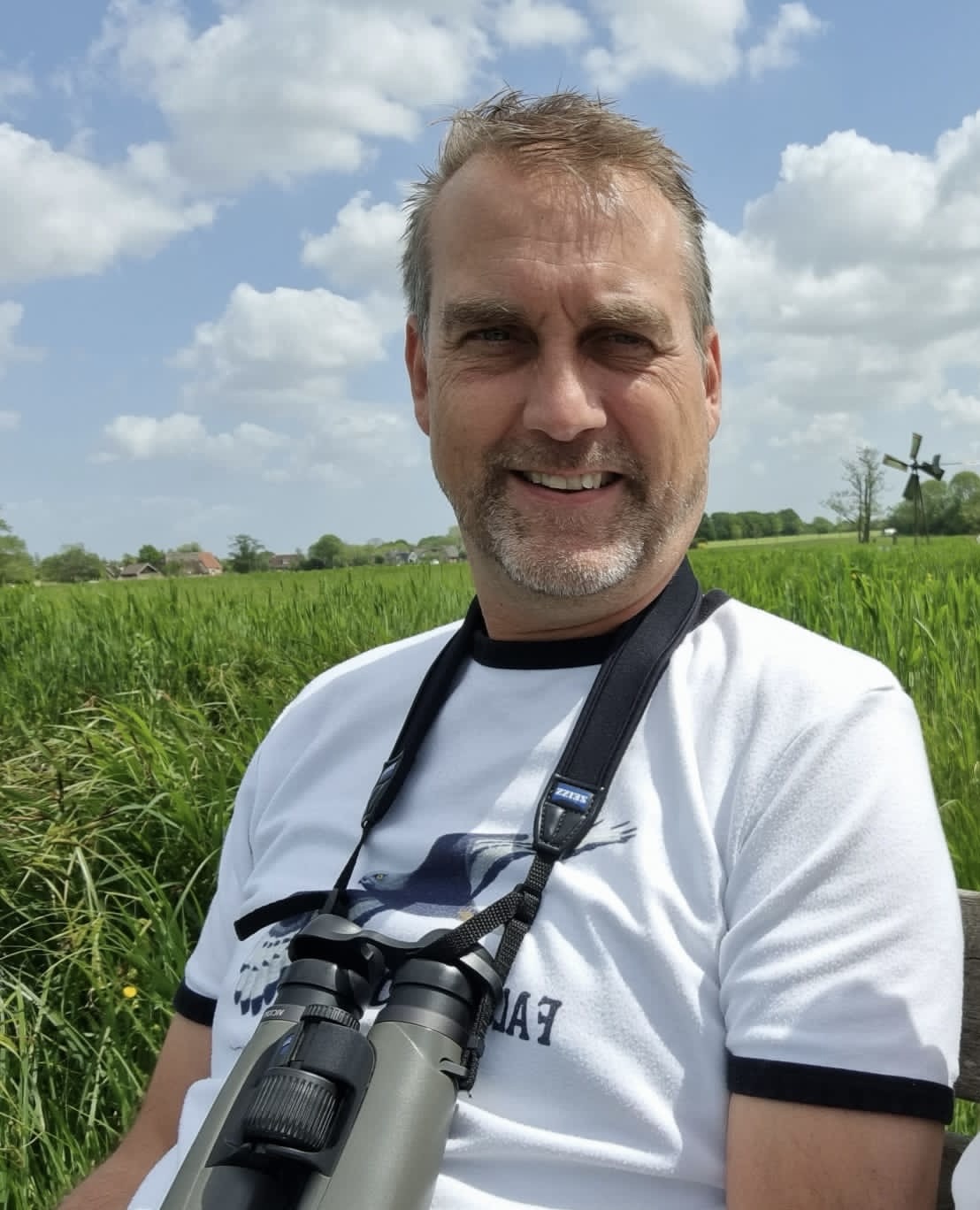
I'm Ronny.
I build EMSN.
A village garden in Nijverdal, a handful of Pis, a Davis station, a few microphones and three nest-box cameras. Here's the story behind it.
I live in Nijverdal and I build EMSN (Ecological Monitoring System Nijverdal): a network of Raspberry Pis that picks up bird sounds 24 hours a day, recognises them, and writes them to a database. Started in the attic with one BirdNET-Pi, out of curiosity, but also because I always want to know which birds are flying over and around the place when I'm not there, or when I'm indoors. By now there are five stations spread across the house, the garden and the field, 110 systemd services running, and more than 1,243,600 detections of 170 species in a PostgreSQL database. On top of that, 197 self-trained CNN models add the vocalisation type: song, call, alarm, flight call, and so on.
I'm a hobbyist researcher and I have no budget. It's a hobby, in my own time, on hardware I expand piece by piece. One Pi sits fixed in the attic, one in the shed, a mobile station travels with me to the Sallandse Heuvelrug to listen for Black Grouse and Nightjar, and since April there's an ultrasonic station for bats too. The code is open on GitHub (@RonnyCHL). I also contribute to the BirdNET-Pi community via the Nachtzuster fork.
Why? You protect what you know. What started as a bit of tech to get to know my own garden better has got out of hand. By now I know more about what sings here during the day and flies over at night than I ever expected. And that's not something you can stop.
How that recognition works, how I filter out people's speech and how I choose what reaches the site, is on the method page.
- Place
- Nijverdal
- Started
- 2025
- Type
- Hobby
- Stations
- 7 + 3 cams
For me, this is the heart of it: valuable biodiversity data comes, in the long run, from people who keep measuring at one spot year after year. One recording already tells you something, one year tells you more, ten years is where it really gets interesting. That's when you start seeing trends.
The good thing: anyone can do this now. The hardware costs a fraction of what it used to, the models are open and free, and there's a community willing to help. What you need is a Raspberry Pi, a microphone, and the patience to get it all working.
Citizen science, some people call it: amateurs measuring in their own gardens and sharing what comes by. In places no researcher ever visits, this is often the only thing that gets measured. And the more people join in, the more complete the picture becomes.
Question, comment, or thinking of setting up something similar? Drop me an email. The system itself and this site are both open on GitHub, so you can also just read the code.
Every email gets read personally. I always reply.